Angležko 2.0: from quiz app to learning path
Version 1.0 was a quiz. 2.0 is a different app wearing the same name — and the reason comes down to one thing about how we remember words.
The first version of Angležko was a quiz. You picked a lesson, answered ten questions, collected points and moved on. It worked — and it had a flaw I didn't see until I looked at the data.
People were finishing lessons. They weren't learning words.
The difference is that you can answer "what's the English for sneži" correctly three times in one week and have no idea a month later. A quiz never notices. It shows you a green tick and moves on, and you walk away feeling like you know it — right up until somebody asks you out loud.
Everything 2.0 is grew out of that one observation.
One path instead of a hundred exercises
The list had to go first. In 1.0 your lessons sat in chapters and you picked which one to open. That sounds like freedom. In practice it's a toll: every time you open the app, you have to make a decision before you're allowed to start learning. Most people don't decide. They close the app.
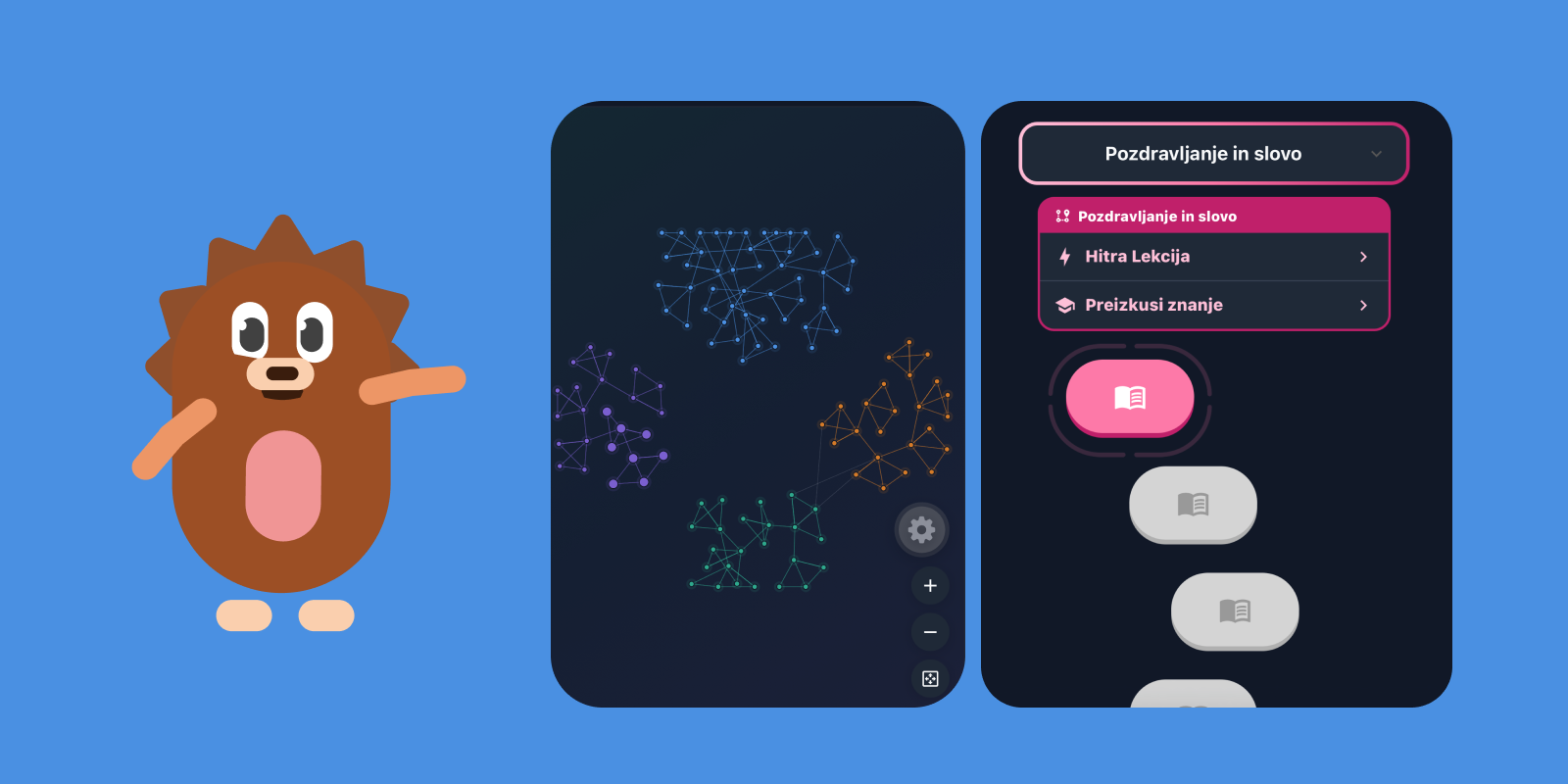
Now there's a learning path. You choose a topic once, and after that there's only the next circle in front of you. Every lesson has four parts, and at the end of a topic the Golden Lesson picks up everything at once.
There are 120 topics in the app, from first words to media literacy and negotiation — A1 through C1. Underneath them sit 2,347 lessons and nearly 30,000 exercises. In 1.0 there were 207 lessons.
An app that knows when you're about to forget
The idea is simple. Making it work is not. Every word you meet carries a score for how firmly you actually hold it. Answer correctly and the next review drifts further out. Get it wrong and it moves closer. The word comes back exactly when you're on the edge of losing it — not sooner, because that's boring, and not later, because by then it's gone.
I didn't invent this. Spaced repetition is an old research result and every serious vocabulary program uses it. What's new is that you can see it: the Knowledge Map shows every word you've met as a constellation of connected points, and how strongly you really know each one.
The first time I opened it with my own account I was disappointed by my number. That was a good sign — it meant the thing was measuring something real, and not how much I'd been tapping.
Ježek
The mascot was one of the main things I wanted in 2.0. Not a sticker added at the end, but something that was in the plan from the start.
The reason is simple: when you're learning alone on a phone, nothing answers back. You get it right and nothing happens. You get it wrong and nothing happens either. That's the gap between learning with someone and staring at a screen, and that gap is what decides whether you come back tomorrow.
So Ježek — a hedgehog, and the word means exactly that in Slovenian — is in every lesson. He reacts to right answers and to wrong ones, walks you through onboarding, and on Sunday he gives you his opinion of your week. He isn't there to nag you. He's there so you aren't doing this alone.
The whole onboarding was rebuilt alongside him. The first version looked far too much like the thing you already have on your phone — rounded buttons, loud colours, everything shouting. It felt familiar, and that was exactly the problem: a weaker take on something people already own. Better to be your own thing and risk someone disliking it than to be the second-best copy of someone else's.
The part that ate the most time wasn't the design. It was one second — when the question headline should start typing itself out, so it doesn't fire while the screen is still sliding in. Nobody notices that kind of thing until it's done right.
Everything else
Streaks count consecutive days. You don't learn a language in one long afternoon, you learn it in ten short ones, which makes the streak the strongest tool in the app. Miss a day and a freeze covers it.
Challenges and monthly badges. A daily challenge, duels against friends, and a badge that stays on your profile for good.
The Sunday report. A look back at your week, with Ježek's verdict on it.
An avatar you build yourself, so your progress wears your face instead of a stock one.
Focus Mode. On iPhone you can lock away the apps that distract you until your lessons are done. You make the decision once; the phone handles the rest.
A family plan for up to six people, and school accounts, where a pupil signs in with a card handed out in class — no email, no password.
What fought back
Five months was not five months of writing new features.
The app went through two major platform upgrades along the way, to Expo SDK 57 and React Native 0.86. An upgrade like that is usually one line in a file and a week of working out which library it quietly broke. Three had to be replaced or removed outright because nobody maintains them any more.
For a while the app opened to a black screen — only in production builds, never in development. Those are the worst kind, because you can't watch them happen. You only see the result and have to reason backwards.
The one I remember best is the avatar leaking between accounts on the same device. Log out, log in as someone else, and you're looking at a stranger's face. Innocent in the code, maddening in practice.
How much of it there is
Most of the work went into new features — and into content.
The learning path, spaced repetition, the Knowledge Map, challenges, duels, monthly badges, the Sunday report, avatars, Focus Mode, the family plan, school accounts. Each one is its own screen, its own tables, its own server routes, and its own pile of edge cases you only find once somebody else holds the thing.
The other half is content, and you can't see it from inside the app. 120 topics, 2,347 lessons, 29,871 exercises. Every topic needs a name, a description, a level, theory and a word list. Every lesson knows which words it introduces and what has to be finished before it. Every exercise needs a type, a prompt, a correct answer, plausible wrong answers and a difficulty — and if a single wrong answer is too easy, the exercise tests nothing at all.
For comparison: 1.0 had 207 lessons and 1,854 questions. That's eleven times the lessons and sixteen times the exercises.
On top of that sits everything that is neither a feature nor content: Google and Apple sign-in, subscriptions across three platforms, notifications, ads, security codes, error monitoring, the teacher portal. None of it appears in a changelog, and without it nothing runs.
A quiz is fun and forgettable. An app that remembers what you forgot is less fun for one afternoon and far more useful over a year.